Queer as Flowers: Why Queer Representation Doesn't Need a Rainbow
When most people think of queer symbols, the rainbow flag is usually the first thing that comes to mind. And it's a powerful one - it's done incredible work for visibility and solidarity since Gilbert Baker first stitched it together in 1978. But queer history didn't start with the rainbow, and queer symbolism doesn't end with it either.
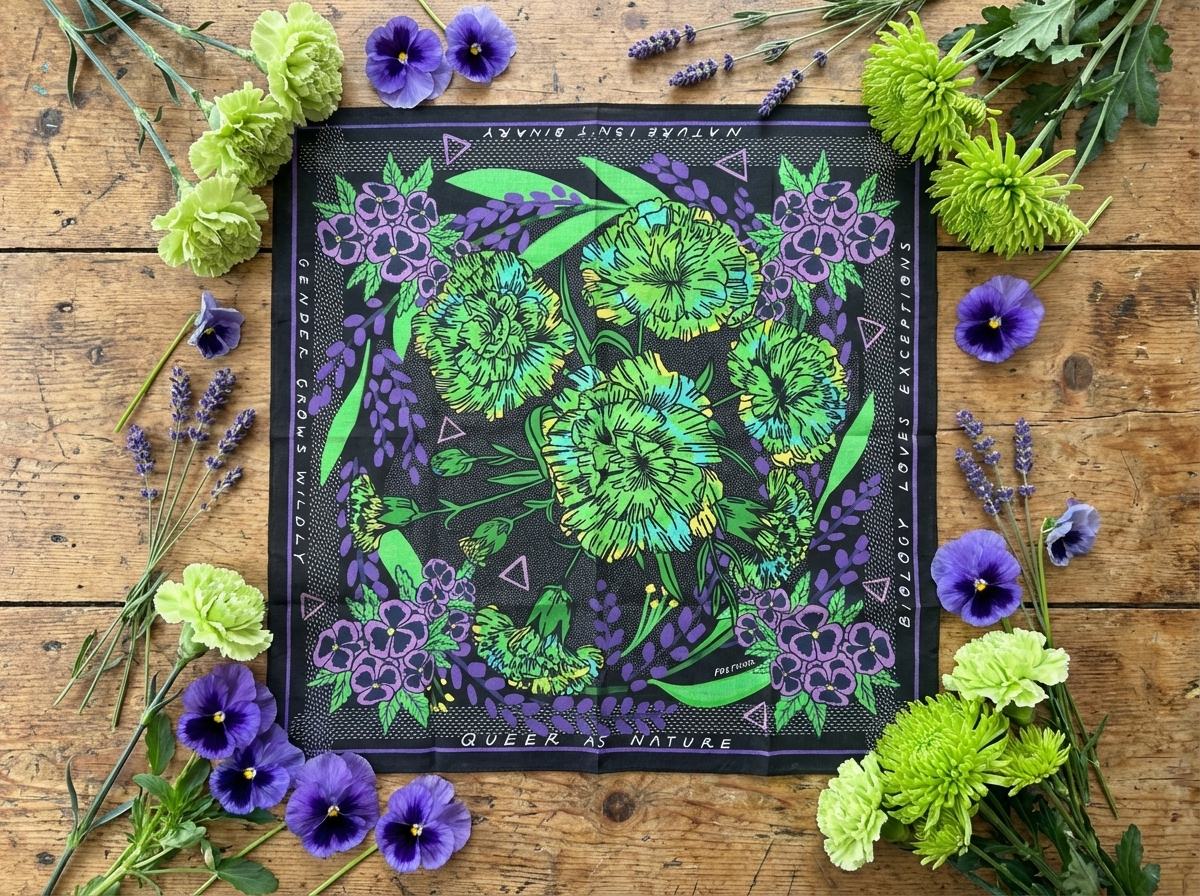
That's part of why I created the Queer as Flowers bandana - a design rooted in the idea that nature itself has always been a quiet, radical symbol of queerness. Long before pride flags, queer people used flowers to find each other, express desire and signal identity in ways that were hidden in plain sight.
The flowers and what they mean
Each flower in this bandana was chosen for a reason.
Violets
Violets have one of the longest associations with queer love. The connection goes all the way back to the poet Sappho, who wrote about women wearing garlands of violets on the island of Lesbos around 600 BCE. By the early 20th century, giving violets to a woman had become a quiet way for women who loved women to express romantic interest. In the 1920s, a play called 'The Captive' featured a woman sending violets to another woman as a symbol of their love - it caused a scandal and was shut down, but it cemented violets as a sapphic symbol for decades.
Lavender
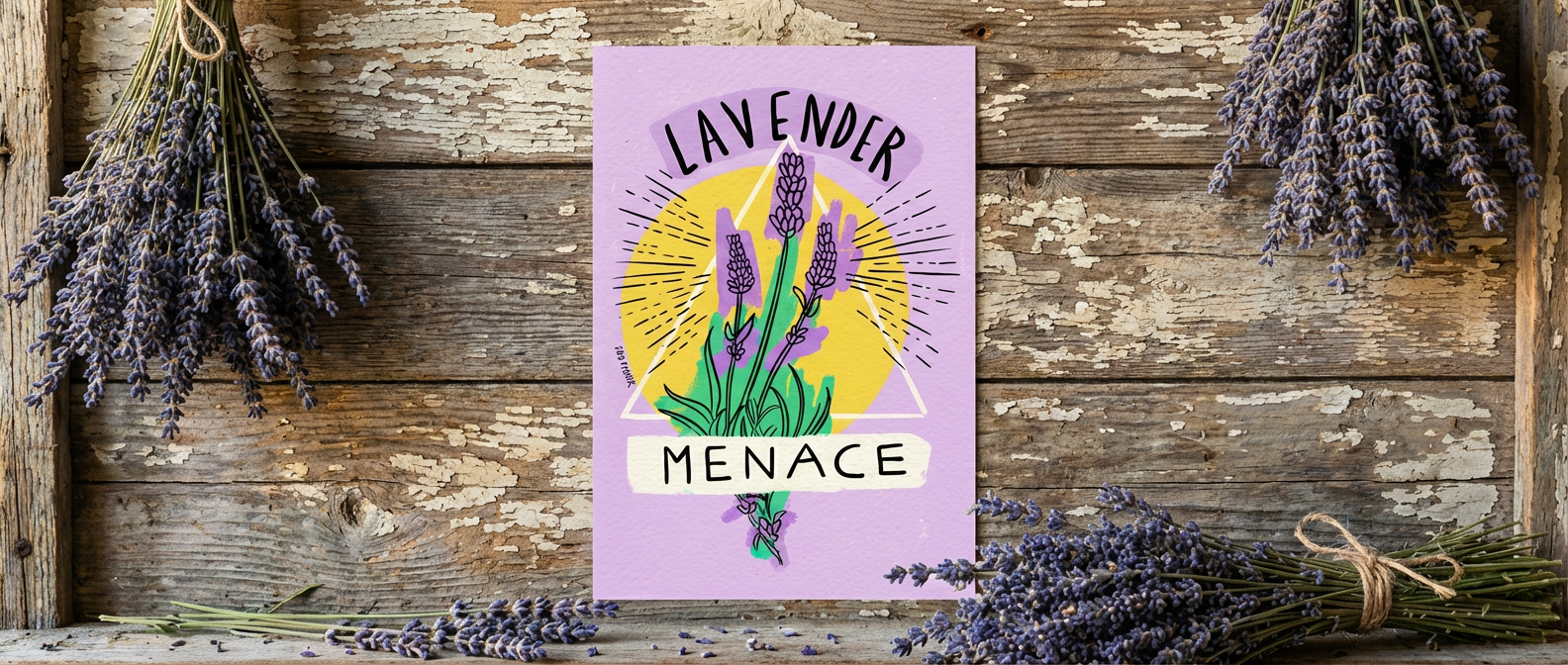
Lavender has deep roots in queer culture - so deep that the colour itself became shorthand for queerness. The term 'lavender' was used as a coded reference to homosexuality as far back as the early 1900s. In the 1950s and 60s, the 'Lavender Scare' in the US saw thousands of LGBTQ+ people fired from government jobs. And in 1970, lesbian activists reclaimed the insult 'Lavender Menace' by storming the stage at the Second Congress to Unite Women, turning a slur into a declaration of pride. The colour and the plant carry all of that history.
Green carnations
The green carnation is one of the most distinctive queer flower symbols. In the 1890s, Oscar Wilde asked his friends to wear green carnations to the opening night of one of his plays. It became a secret signal - a way for gay men in London and Paris to recognise each other. Robert Hichens even wrote a satirical novel called 'The Green Carnation' in 1894, inspired by Wilde's circle. The flower doesn't occur naturally in green, which made it the perfect symbol - something beautiful and deliberately outside the norm.
Wild foliage
Woven through the whole design is wild foliage - untamed, unstructured, growing however it grows. It's there because queerness isn't a manicured garden. It's wild. It doesn't follow a neat pattern, and it doesn't need to.
Why not just use a rainbow?
I love the rainbow flag. I've carried it, worn it, waved it at Pride events. But I think there's real value in queer representation that goes deeper than one symbol. The rainbow is instantly recognisable, and that's its strength - but it can also flatten the richness of queer history into a single image. There's so much more to draw from.
Flowers let me tell a story that's layered and rooted in centuries of queer resilience. They connect us to people who lived and loved in times when they had no flag to wave, only a flower to pin to their lapel or slip into someone's hand. That kind of history deserves to be visible too.
I also wanted to create something that felt wearable in a different way - something subtle enough that you might not clock it as queer at first glance, but unmistakable once you know what you're looking at. Not everyone wants to wear a flag. Some people want something that sits a little quieter, but carries just as much meaning.
Queerness isn't a deviation from nature. It is nature.
The bandana is framed with four phrases: 'Gender Grows Wildly', 'Biology Loves Exceptions', 'Nature Isn't Binary' and 'Queer As Nature'. I wanted to include these because so much of the pushback against queer and trans people relies on the argument that we're somehow 'unnatural'. The reality is the exact opposite.
Nature is full of variation. Organisms change sex, exist beyond binaries, reproduce in ways that don't fit neat categories. Biology genuinely does love exceptions; it's one of its defining features. Gender, like a garden, grows in directions you can't always predict.
These phrases aren't slogans - they're facts dressed up as poetry. I wanted them woven into the design so that every time someone wears or displays this bandana, they're carrying a quiet counter-argument to anyone who says queer people don't belong.
How to wear it
The Queer as Flowers bandana is printed on 100% cotton and measures 56cm x 56cm. You can wear it however you like - around your neck, in your hair, on your bag - or frame it as a piece of art. It's stocked at Queer Britain Museum in London, and you can also pick one up from my shop.

Written by Fox Fisher